
Cos Value List Chart, Formula And Memory Trick
Trigonometry plays a fundamental role in mathematics, physics, engineering, and many real-world applications. Among the key trigonometric functions, cosine is one of the most commonly used. Students frequently search for a cos value list to quickly recall the cosine values of standard angles. Understanding this list helps simplify calculations and strengthens conceptual knowledge in trigonometry.
What Is Cosine in Trigonometry?
Cosine is one of the primary trigonometric functions used to describe relationships in a right-angled triangle. It is defined as the ratio of the adjacent side to the hypotenuse.
\cos \theta = \frac{\text{Adjacent}}{\text{Hypotenuse}}
This formula helps determine the cosine of an angle when the sides of a triangle are known. However, for commonly used angles, mathematicians have already calculated the values. These values together form what is known as the value list.
Cos Value List for Standard Angles
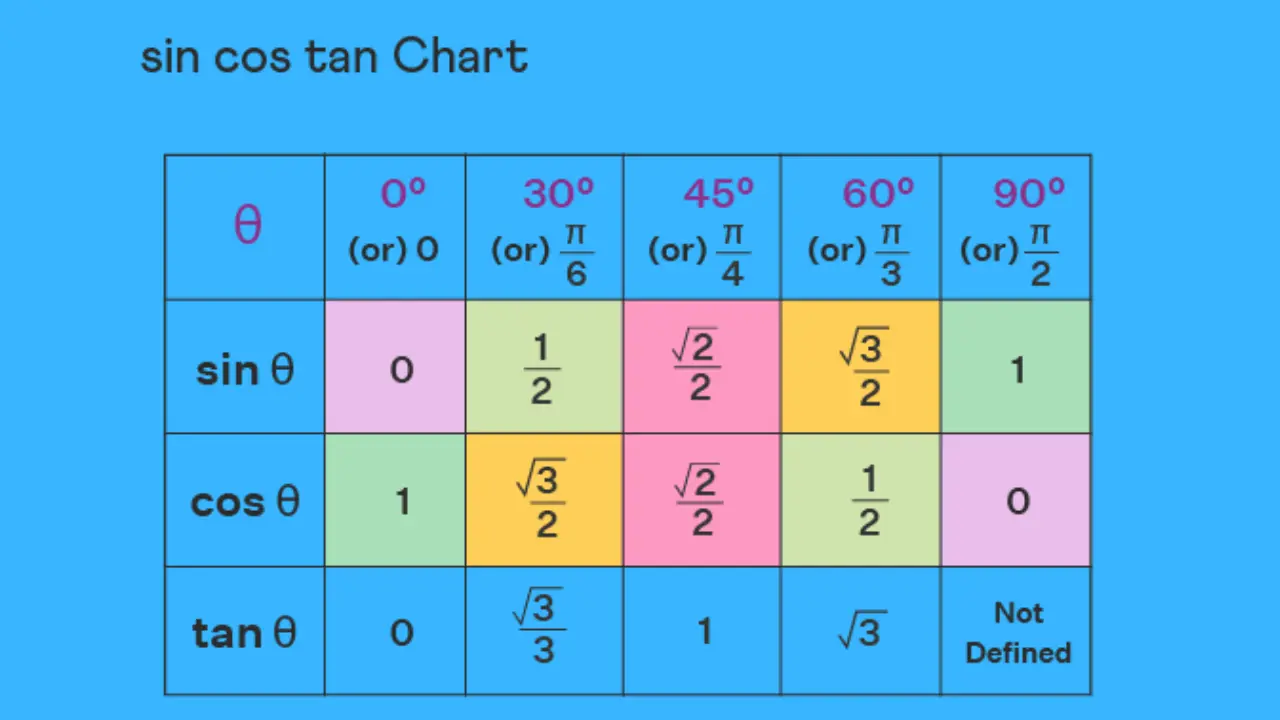
The value list includes the cosine values for commonly used angles such as 0°, 30°, 45°, 60°, and 90°. These angles are widely used in trigonometric calculations.
| Angle (θ) | Cos θ Value |
|---|---|
| cos 0° | 1 |
| cos 30° | √3 / 2 |
| cos 45° | 1 / √2 |
| cos 60° | 1 / 2 |
| cos 90° | 0 |
Cos Value List in Decimal Form
Sometimes cosine values are required in decimal form for practical calculations. Below is the decimal representation of the value list.
| Angle | Cos Value (Decimal) |
|---|---|
| 0° | 1.000 |
| 30° | 0.866 |
| 45° | 0.707 |
| 60° | 0.500 |
| 90° | 0 |
Using this cos value list in decimal format is helpful for engineering calculations and physics problems where approximate values are acceptable.
How the Cos Value List Is Derived
The cos value list is derived using geometric constructions of special triangles.
45°–45°–90° Triangle
In this triangle, the two legs are equal.
If each leg = 1
Hypotenuse = √2
Therefore:
cos 45° = adjacent / hypotenuse = 1 / √2
30°–60°–90° Triangle
This triangle provides two important cosine values.
If hypotenuse = 2
- Adjacent to 30° = √3
- Adjacent to 60° = 1
Thus:
- cos 30° = √3 / 2
- cos 60° = 1 / 2
These geometric relationships form the foundation of the cos value list.
Cos Value List Trick to Remember Easily
Many students struggle to memorize trigonometric values. Fortunately, there is a simple pattern that makes remembering the cos value list much easier.
For cosine values of angles:
0°, 30°, 45°, 60°, 90°
Follow this sequence:
√4 / 2
√3 / 2
√2 / 2
√1 / 2
√0 / 2
Which simplifies to:
1
√3 / 2
1 / √2
1 / 2
0
This trick helps students quickly recall the cos value list during exams and problem-solving.
Cos Value List on the Unit Circle
The cos value list can also be understood using the unit circle. In a unit circle, the radius is 1, and cosine represents the x-coordinate of a point on the circle.
x2+y2=1
θ
P(θ)=(cos(θ),sin(θ))=(22,22)
(22,22)
For example:
- cos 0° = x-coordinate at (1,0)
- cos 90° = x-coordinate at (0,1)
This graphical interpretation explains why cosine decreases from 1 to 0 as the angle increases from 0° to 90°. Understanding the unit circle makes the cos value list easier to visualize and remember.
Importance of the Cos Value List
The cos value list is essential for students and professionals working with trigonometry. Here are some reasons why it is important:
Faster Problem Solving
Memorizing the cos value list allows you to solve trigonometric equations quickly without calculators.
Foundation for Advanced Mathematics
Many topics such as calculus, vectors, and physics rely on the cosine function.
Real-World Applications
Cosine values are used in:
- Engineering designs
- Architecture calculations
- Physics wave analysis
- Computer graphics
Because of these applications, understanding the value list is crucial in STEM fields.
Common Applications of Cosine Values
The cosine function is widely used beyond mathematics textbooks. Engineers use cosine in structural analysis, while physicists apply it in wave motion and oscillations.
For example, in physics, cosine functions help describe periodic motion such as sound waves and light waves. Similarly, GPS systems and navigation tools rely on trigonometric calculations involving cosine.
In all these scenarios, the value list provides the fundamental values needed for calculations.
Differences Between Sin and Cos Value Lists
Students often compare sine and cosine tables. While the value list starts with 1 and decreases to 0, the sine value list starts with 0 and increases to 1.
For example:
| Angle | Sin θ | Cos θ |
|---|---|---|
| 0° | 0 | 1 |
| 30° | 1/2 | √3/2 |
| 45° | 1/√2 | 1/√2 |
| 60° | √3/2 | 1/2 |
| 90° | 1 | 0 |
This relationship highlights the complementary nature of sine and cosine functions.
Conclusion
The cos value list is one of the most important tools in trigonometry. It provides the cosine values of standard angles, helping students and professionals perform calculations quickly and accurately. By understanding the geometric derivation, using memory tricks, and visualizing values on the unit circle, anyone can master the cos value list with ease.
Whether you are preparing for exams, solving mathematical problems, or working in engineering or physics, knowing the cos value list will make trigonometry much easier and more efficient.